Quick answer: Home heating fires start climbing in October, when most Middle Tennessee families first switch on the furnace, light the fireplace, or plug in a space heater. NFPA figures for 2016 to 2020 show roughly twice as many heating fires in October as in September, and nearly half of all heating fires happen from December through February. The best defense is simple: have the furnace and chimney checked, keep anything that can burn at least 3 feet from heat sources, and turn space heaters off when you leave the room. If a fire does happen, even a small one, smoke and soot spread through the house fast. Professional smoke damage restoration in Spring Hill, Columbia, and nearby towns can clean, deodorize, and rebuild what was affected. Call AMC Restoration at (931) 416-5131.
Why October Is When Heating Fire Risk Starts
Heating season sneaks up on us here. NWS Nashville climate normals put the average October low at 49.9°F and the November low at 39.2°F, with the average first 32°F morning at the Nashville airport on November 11. Columbia usually gets there sooner. The NWS freeze probability table for the Columbia station gives a 50 percent chance of the first 32°F reading by about October 19. Those first cold nights are when furnaces that sat idle all summer kick back on, fireplaces get their first fire of the year, and space heaters come out of the closet.
The fire numbers follow the thermometer. NFPA’s table of home heating fires by month (2016 to 2020 annual averages) shows about 1,550 in September, 3,060 in October, 4,720 in November and 6,510 in December, with January the peak at 8,080. On its home heating safety page, NFPA reports that fire departments responded to an estimated average of 37,365 heating equipment fires per year from 2020 to 2024, about 11 percent of all reported home fires, and that 46 percent happened from December through February.
The U.S. Fire Administration puts heating as the second leading cause of home fires in 2021, behind cooking. October also brings Fire Prevention Week, which NFPA has set for October 4 to 10, 2026. This year’s campaign is about safely charging lithium-ion batteries in phones, tools, and scooters, which is worth a look while you are walking the house with a flashlight anyway.
The Heating Equipment Behind Most Fires
Space heaters
Space heaters cause a small share of heating fires but a large share of the harm. In NFPA’s 2020 to 2024 figures, space heaters and heating stoves were involved in about 30 percent of home heating equipment fires but 73 percent of the deaths. USFA adds that portable heater fires were only 3 percent of home heating fires in 2017 to 2019 yet accounted for 41 percent of fatal heating fires in homes. Most of those fires start the same way: a heater too close to a bed, a couch, curtains or a pile of laundry.
Fireplaces and chimneys
NFPA found that larger fires involving fireplaces or chimneys made up only 6 percent of heating equipment fires but caused nearly one fifth (19 percent) of the direct property damage. A flue that has not been swept in a few seasons, a cracked liner or embers landing on a rug are the usual stories we hear afterward.
Furnaces and central heat
Many heating fires never leave the furnace or the flue. USFA’s report on residential building heating fires from 2017 to 2019 found that 77 percent were confined to chimneys, flues, or fuel burners. A confined fire is good news for the structure, but it can still push smoke and soot through the ductwork and into every room the system serves. That is often the first restoration call of the season.
A Heating Season Checklist for Your Home
None of this costs much, and most of it can be done in an afternoon. The list below pulls from NFPA, USFA and Ready.gov home fire guidance.
- Have your furnace, fireplace, wood stove, and chimney cleaned and inspected by a qualified professional every year before the first cold snap.
- Keep anything that can burn at least 3 feet from furnaces, fireplaces, wood stoves, radiators, and space heaters.
- Turn space heaters off when you leave the room or go to bed, and plug them straight into the wall.
- Never use an oven to heat your home.
- Put smoke alarms on every level of the house, including the basement, test them monthly, and replace the whole unit every 10 years or as the manufacturer recommends.
- Plan two ways out of every room in case one is blocked by fire or smoke.
- Change the furnace filter and clear boxes, paint cans, and storage away from the unit.
- Let fireplace ashes cool completely in a metal container with a lid, stored outside away from the house.
What Happens to a House After a Heating Fire
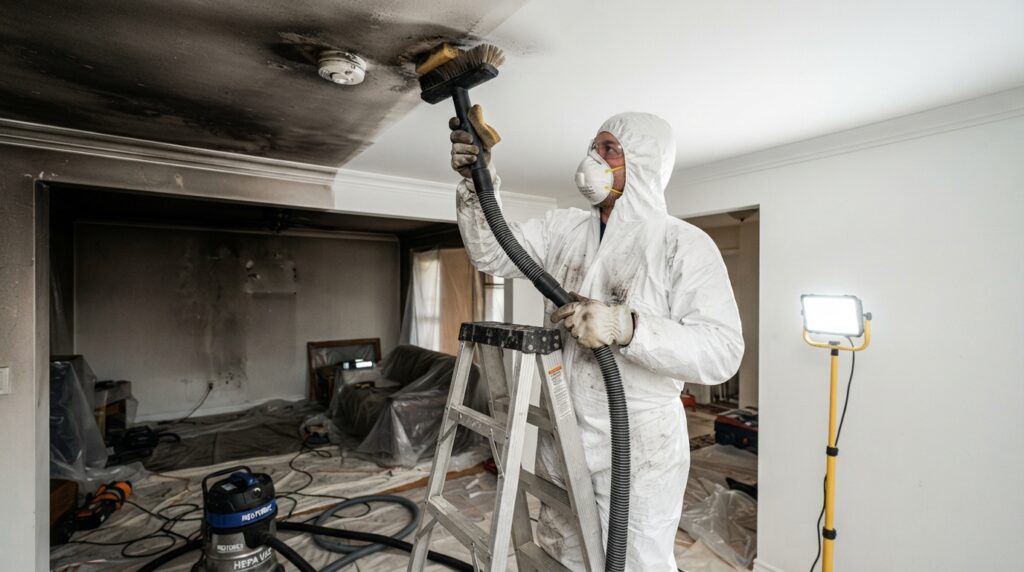
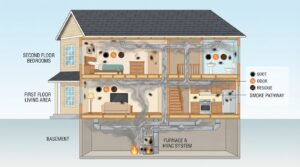
Even a small fire leaves a big footprint. Smoke rises and spreads to rooms the flames never touched. Soot settles on walls and ceilings and inside cabinets and closets. Odor soaks into carpet, upholstery, clothing, and drywall. If the furnace was running, the system can pull smoke through the ducts and deposit residue in every room it serves. And if the fire department put water on the fire, you may have wet floors, walls, and insulation on top of the smoke.
Why soot should not be wiped right away
The instinct is to grab a wet rag. Wiping soot with water often smears it deeper into paint, grout, and textured ceilings and makes the stain harder to remove. Different surfaces need different cleaning methods, so it pays to have the house assessed before anyone starts scrubbing.
Your HVAC system and ductwork
Hold off on running the furnace until it has been checked. University of Tennessee Extension guidance on smoke removal and fire cleanup in the home recommends having heating and air conditioning units and all ductwork professionally cleaned to remove soot, ash and smoke residue, then changing filters when you first return and at least once a month for the first year. That guide was written for wildfire smoke, but the same advice holds for smoke from a fire inside the house.
What Smoke Damage Restoration Looks Like
Every job is a little different, but our fire and smoke damage restoration work follows the same basic path.
- Emergency response: we secure the property and check what is safe to enter.
- Damage assessment: we walk the whole house, document the damage, and build a restoration plan.
- Mitigation and cleanup: soot removal from walls, ceilings, and surfaces, plus water removal and drying if firefighting left things wet. Our water damage restoration team handles that part.
- Contents and odor: furniture, clothing, and personal items get cleaned and deodorized through our contents and odor restoration
- Repair and reconstruction: damaged drywall, framing, flooring, and finishes are rebuilt through our reconstruction service.
- Final inspection: we walk through the finished work with you.
How long it takes depends on the size of the fire, how far the smoke traveled, and how much has to be rebuilt. We explain the stages in more detail in our post on how long fire damage restoration takes.
Insurance After a Heating Fire
Every policy is different, so call your insurance company as soon as everyone is safe and ask how they want you to proceed. Take photos and video of every room before cleanup starts, and hold on to damaged items until the adjuster has seen them unless they are a safety hazard. The UT Extension guide also suggests keeping a record of cleaning contracts and expenses for insurance purposes. We cannot promise what your policy will pay for, but our insurance claim service can help you document the damage and keep the paperwork organized for your adjuster.
Is It Safe to Go Back In?
Not until the fire department says so. Ready.gov advises checking with the fire department to make sure your home is safe to enter after a fire. Once you are cleared, open windows if the weather allows, wear gloves and an N95 mask while handling anything sooty, as the UT Extension guide recommends, and keep children and pets out of affected rooms until cleaning is done.
Frequently Asked Questions
When are home heating fires most common?
NFPA data shows 46 percent of home heating equipment fires happen from December through February, and January is the single busiest month. The climb starts in fall, with October running about twice as many heating fires as September in NFPA’s 2016 to 2020 averages.
How far should a space heater be from furniture and curtains?
NFPA and USFA both say to keep anything that can burn at least 3 feet from space heaters and other heat sources. Turn the heater off when you leave the room or go to sleep.
Can smoke damage spread to rooms the fire never reached?
Yes. Smoke moves with air, so it travels through open doors, stairwells, and especially the HVAC system. Soot and odor often turn up in bedrooms and closets far from where the fire started.
Should I clean soot myself?
Light dust on a hard surface may be manageable, but wiping soot with water often smears it and sets the stain. Large areas, fabrics, ceilings, and ductwork are better left to a restoration crew. If you do handle sooty items, wear gloves and an N95 mask.
Does homeowners insurance cover smoke damage from a heating fire?
That depends on your policy, so call your insurer early and ask. Document everything with photos before cleanup. We can help organize documentation for your claim, but we cannot promise what any policy will cover.
How long does smoke damage restoration take?
It depends on how big the fire was, how far the smoke spread, whether there is water damage from firefighting, and how much needs to be rebuilt. A small, confined furnace fire is a very different job from a fire that burned through a room.
Does AMC Restoration handle fire and smoke damage in Spring Hill and Columbia?
Yes. We are based in Columbia and handle fire and smoke damage restoration in Spring Hill, Franklin, Thompson’s Station, Mt Pleasant, and other towns in the area. Call (931) 416-5131 to talk through what happened.
Talk to AMC Restoration About Fire or Smoke Damage
If a heating fire, even a small one, has left smoke, soot, or odor in your home, call AMC Restoration at (931) 416-5131 or reach us through our contact page. We serve Columbia, Spring Hill and communities across Maury and Williamson counties, and we will walk you through what to do next.