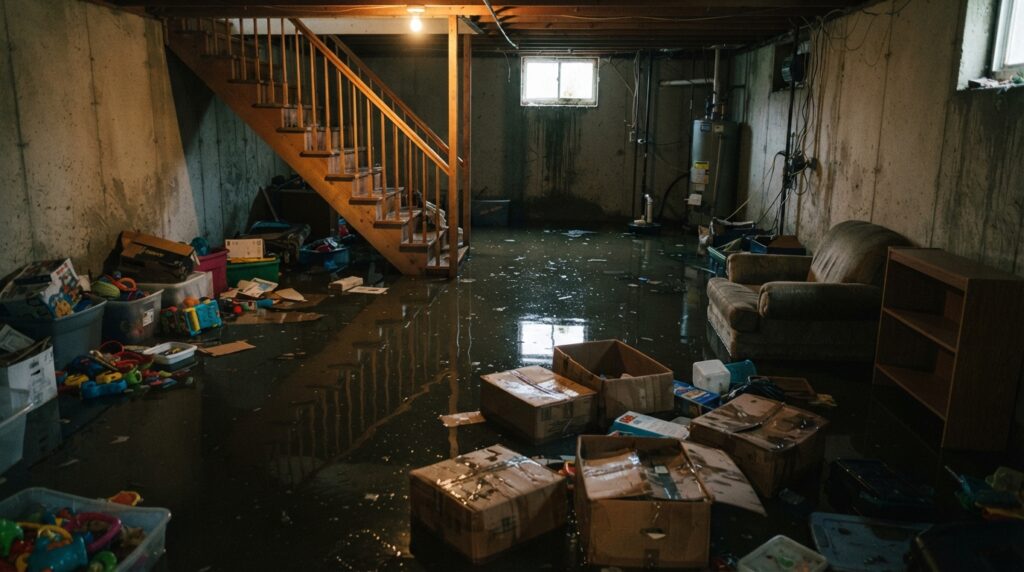
Quick answer: If fall rain has put water in your basement in Columbia, Spring Hill or anywhere in Maury County, start with safety. Stay out of standing water until the power to that area is off, and never walk through water near outlets or appliances. Then stop the source if you can, move belongings to a dry spot, take photos, and get the water out and the space drying fast. The EPA says wet materials dried within 24 to 48 hours usually will not grow mold, so the first two days matter most. If the water is deep, keeps coming back, or has soaked drywall, carpet or framing, call AMC Restoration at (931) 416-5131.
Why Basements Take on Water in a Middle Tennessee Fall
October is usually one of our drier months. NWS Nashville climate records list 3.36 inches as normal October rainfall at the Nashville airport, with about seven days of measurable rain, the fewest of any month. A normal month can still carry one bad storm, though. The same records show 3.18 inches falling in a single October day back in 1928, and October 2014 brought 8.43 inches, the wettest October on the books there. November is wetter still, with a normal of 3.86 inches.
This year has an extra wrinkle. The NOAA Climate Prediction Center outlook for October through December 2026 says El Niño is present and favors above-normal precipitation for much of the Mississippi and Tennessee Valleys. For our corner of Middle Tennessee, the outlook map leans wetter than normal for those three months. An outlook is not a forecast for any single storm, but it is a good reason to get ready now.
Then there are the leaves. Gutters and downspouts packed with oak and maple leaves overflow right at the foundation, and that water finds the easiest way in: a floor crack, a basement window well, the joint where the wall meets the slab, or the vents on homes that sit over a crawl space instead of a full basement.
Common ways water gets in
- Clogged gutters and short downspouts that dump roof water right beside the foundation
- A sump pump that fails, loses power in a storm, or simply cannot keep up
- Window wells that fill with leaves first and water second
- Soil or mulch that slopes toward the house instead of away from it
- Groundwater pushing through cracks after several days of steady rain
- Plumbing leaks, a failed water heater or a burst washing machine hose
First Steps When You Find Water in the Basement
1. Make it safe
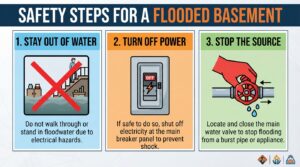
Water and electricity together are the real danger. If outlets, cords, a furnace or a water heater are sitting in water, do not step in. Shut off power to the basement at the breaker panel only if you can reach the panel while standing on dry ground. If you cannot, call your utility or an electrician. If you smell gas, leave the house and call the gas company from outside.
2. Stop the source if you can
If the water is coming from a pipe or an appliance, close the main water shutoff. If it is rain, clear the gutters and pull downspouts away from the house once the storm passes and it is safe to be on a ladder. If the sump pump has quit, check the breaker and the float switch before you assume the pump is dead.
3. Document before you clean
Photograph the water line on the walls, the floor and every damaged item before anything gets moved or tossed. Ready.gov recommends keeping photos of your belongings for insurance claims, and good pictures help later no matter who ends up paying for the work.
4. Move what you can
Carry boxes, rugs, electronics and furniture to a dry floor. If a wood piece has to stay put, set the legs on foil or plastic blocks. Pull up throw rugs so the floor underneath can start drying.
5. Get the water out and start drying
A shop vacuum can handle a small puddle on bare concrete. Anything more than that, or water that has wicked up into drywall, trim, or carpet pad, calls for pumps, extraction equipment, air movers, and dehumidifiers sized for the space. That is the work our water damage restoration crew handles.
The 24 to 48 Hour Window and Mold
Mold is the problem that shows up after the water is gone. The EPA puts it plainly in its brief guide to mold, moisture and your home: dry water-damaged areas and items within 24 to 48 hours to prevent mold growth. With October afternoons still reaching the low 70s on average (NWS lists a normal October high of 73.5°F), a damp basement in Maury County has everything mold needs.
Drying a basement is not like drying a kitchen floor. Concrete holds water, drywall wicks it upward, and the bottom plate of a framed wall can stay wet long after the surface feels dry to the touch. That is why we measure instead of guessing. Our structural drying and mitigation work uses moisture readings to find wet spots behind walls and under flooring, then keeps the equipment running until the materials are actually dry.
If you can already see mold, the same EPA guidance says that growth covering more than about 10 square feet, or mold after a lot of water damage, calls for more than a bucket and sponge. A musty smell in a finished basement after a wet week is worth checking even when nothing is visible yet.
What usually has to come out
- Carpet pad that has been soaked (the carpet itself can sometimes be saved if the water was clean and it dries quickly)
- Drywall that has wicked water above the flood line, usually cut out a little above the wet mark
- Wet insulation inside finished walls
- Cardboard boxes, books, and paper goods that sat in water
Clean Water, Gray Water, and Floodwater Are Not the Same
A supply line leak is usually clean at first. Floodwater from outside, or anything that backed up through a floor drain, can carry sewage and bacteria, so handle it only with gloves and boots, and expect porous items it touched to be thrown out. Tell us the source when you call, because it shapes the plan.
How to Get Ahead of Fall Rain This October
A few hours of work in October can save a finished basement. Ready.gov lists decluttering drains and gutters, installing check valves, and considering a sump pump with a battery as flood prep steps. Here is how that looks at a house in Columbia or Spring Hill:
- Clean gutters after the leaves come down, not before. In most Maury County yards, that means late October into November, and sometimes twice.
- Add downspout extensions so roof water lands several feet from the foundation.
- Test the sump pump by pouring a bucket of water into the pit and watching it cycle. Make sure the discharge line is clear and not buried under leaves.
- Think about a battery backup for the pump, since the fall storms that knock out power are the same ones that fill the pit.
- Clear window wells and add covers if leaves keep piling up in them.
- Check the grading. Soil and mulch should slope away from the house.
- Move valuables, photos and paperwork off the basement floor and onto shelves.
And stay off flooded roads when the heavy rain comes. The National Weather Service Turn Around Don’t Drown campaign notes that just 6 inches of fast-moving water can knock over an adult and 12 inches can carry away most cars.
What About Insurance?
Coverage depends on your policy and on how the water got in, so call your agent or insurance company early and ask. As a general point, Ready.gov notes that homeowners policies do not cover flooding and that a flood policy typically takes up to 30 days to go into effect. A burst pipe, a failed appliance or a sump pump backup may be treated differently, and some of those need an added endorsement. We cannot tell you what your policy covers, but our insurance claim service can help you document the damage and keep the paperwork organized for your adjuster.
When to Call a Restoration Company
A damp corner after a storm may be a weekend project. Call a professional when:
- Water is more than an inch or two deep, or covers most of the floor
- Drywall, carpet, paneling, or framing got wet
- The water came from outside or up through a floor drain
- The basement smells musty after it seemed dry
- The same spot floods every time it rains hard
- You cannot reach the breaker panel safely
We work in Columbia, Spring Hill, Franklin, Thompson’s Station, and other towns across Maury and Williamson counties. The full list is on our service areas page. If your belongings took on water, our contents and odor restoration service handles cleaning and drying personal property separately from the structure.
Frequently Asked Questions
How fast should a flooded basement be dried out?
The EPA says drying wet materials within 24 to 48 hours usually prevents mold growth, so the goal is to get the water out and drying equipment running right away. Concrete and framing can take longer than that to dry completely, which is why moisture readings should confirm the job is done.
Can I use a shop vac to clean up basement water?
For a small, clean puddle on bare concrete, yes. Once water reaches carpet pad, drywall or framing, a shop vac will not pull out enough moisture to stop mold, and you will need extraction and dehumidifiers.
Should I pump all the water out of a flooded basement at once?
Not if the water is deep and the ground outside is saturated. FEMA flood repair guidance warns that draining a basement too quickly can crack or collapse walls, so deep water should be lowered in stages.
Is basement flooding covered by homeowners insurance?
It depends on your policy and the cause of the water. Ready.gov notes that homeowners policies do not cover flooding, and sump pump backups often need a separate endorsement. Ask your agent before you assume either way.
How can I tell if mold is growing after a basement leak?
Watch for a musty smell, spotting on drywall or baseboards, peeling paint, or allergies acting up when you spend time downstairs. The EPA suggests getting trained help when mold covers more than about 10 square feet or follows heavy water damage.
Does fall weather really raise basement flood risk in Middle Tennessee?
October is usually one of the drier months, but a single storm can still drop several inches, and falling leaves clog gutters right when rain returns. The NOAA outlook for October through December 2026 also leans wetter than normal for the Tennessee Valley with El Niño in place.
What areas does AMC Restoration serve for basement water cleanup?
We are based in Columbia and work across Maury and Williamson counties, including Spring Hill, Franklin, Thompson’s Station and Mt Pleasant, plus nearby towns such as Lewisburg and Pulaski. Call (931) 416-5131 to talk through your situation.
Water in Your Basement? Call AMC Restoration
If fall rain has found its way into your basement, call AMC Restoration at (931) 416-5131 or send us a message through our contact page. Tell us where the water came from, how deep it is and what got wet, and we will talk you through the next steps. For urgent water, fire or storm problems, you can also start from our emergency restoration page.